The Question That Makes Your Advisory Practice Easier to Run
The Question That Makes Your Advisory Practice Easier to Run
Most advisory firms do not have a technology problem first.
They have a definition problem.
If you are not clear on what clients are actually hiring you to do, every tool looks like it might help. Every client request feels reasonable. Every deliverable feels like proof that you are earning your fee.
That is how you end up with a bloated tech stack, too many meeting types, too many exceptions, and a service model that is hard to explain because it was never clearly defined in the first place.
I know because I did it.
At one point, I was paying more than $30,000 a year for planning technology. Some of it was genuinely good software. Some of it solved real problems. But when I looked at my actual client meetings, I realized something uncomfortable:
My clients did not care about most of it.
More importantly, they had never asked for most of it.
I had built a stack around what I thought a serious advisor was supposed to use, not around a clear definition of what my clients actually needed from me.
The question that changed my practice
Eventually I asked a few clients a simple question:
What do you actually want from me?
It felt more uncomfortable than it should have. There is something vulnerable about asking clients to define the value of the relationship. You might find out the thing you spend hours preparing is not the thing they care about most.
But the answers were surprisingly consistent.
In different words, they basically said:
We want to understand our financial life and know what we need to do next.
That was it.
Not “show me every projection.” Not “walk me through every assumption.” Not “prove how much work you did behind the scenes.”
They wanted to understand where they stood, what mattered, and what needed to happen next.
That answer became a filter.
Does this meeting help them understand their financial life?
Does this software help me identify or communicate what they need to do next?
Does this deliverable make the next action clearer, or is it just me showing my work?
Once I had that filter, a lot of decisions became easier.
Before you choose the tool, define the job
Advisors often start with the wrong question.
“What planning software should I use?”
“What should my deliverable look like?”
“How often should I meet with clients?”
“What should I include in my service calendar?”
Those questions matter eventually, but they are not the starting point.
The better first question is:
What job are clients hiring us to do?
If the answer is vague, every operational decision gets harder.
“Comprehensive financial planning” might sound good on a website, but it does not tell you what to build, what to automate, what belongs in a meeting, which software matters, or what is extra.
You need a sharper answer.
For my practice, the answer became:
Help clients understand their financial life.
Help clients know what to do next.
That still leaves room for judgment. Different clients need different levels of detail. Some want to kick the tires. Some want the one-page version. Some need more education before they can make a decision.
But once the job is clear, anything that does not support that job has to earn its place.
The restaurant problem
One analogy I keep coming back to is a restaurant.
A lot of advisors start their practice because they like the work and want to help people. That is a good thing. But it can create a strange service model.
Imagine someone opens a restaurant because they love cooking, but they never decide what kind of restaurant it is, who it serves, or what belongs on the menu.
So they try to cook anything for anyone.
Then, because they care so much, they keep running out to the table to show the customer every step.
Here are the ingredients. Here is the sauce. Here is the dish halfway through. Here is why this took so much effort.
Most customers do not want that.
They want a good meal.
Some people want the cooking class. Great. Build that intentionally if that is your thing. But do not accidentally turn every dinner into a cooking class because you feel the need to prove that cooking happened.
Advisors do this all the time.
We show too many assumptions, charts, calculations, and deliverables. Not because clients asked for them, but because we are trying to prove value through visible effort.
Your clients are not paying for effort
This is one of the hardest mindset shifts in advice.
Your clients are not paying you for effort. They are paying for judgment, clarity, confidence, and better decisions.
If you can answer a complicated question in five minutes because you have spent years learning where to look, that is not a problem. That is the value.
The goal is not to make planning look hard enough that your fee feels justified.
The goal is to help the client get to the right understanding and the right next action with as little unnecessary complexity as possible.
That does not mean being lazy, skipping analysis, or giving shallow advice. It means the work behind the scenes should serve the client outcome, not your need to prove that the work happened.
A tactical way to define what you do
If this feels a little too philosophical, here is the practical exercise.
The point is not to copy my answer.
In my practice, the answer became: help clients understand their financial life and know what to do next.
That may or may not be your answer. Your clients may care more about accountability, coordination, confidence, time savings, tax decisions, investment discipline, family communication, or having someone they trust to help them think.
The exercise is to find your answer and then make it specific enough to run the practice.
1. Ask clients what they actually want from you
Do not answer this from your website copy. Ask them.
In a review meeting, try:
“When this relationship is working really well, what does it help you feel clear about?”
Or:
“What do you most want to be able to rely on us for?”
Or even more directly:
“What do you actually want from me as your advisor?”
You do not need a 20-question survey to start. A few real conversations will teach you a lot. Do not rush past this part. The answer is the source material for the rest of the exercise.
2. Translate their answers into jobs, not deliverables
Clients may not describe the value in advisor language.
They probably will not say, “I want a retirement projection, estate planning analysis, risk management review, and tax-aware withdrawal strategy.”
They are more likely to say things like:
“I want to know we are okay.”
“I want someone making sure we do not miss anything.”
“I want help deciding what to do when life changes.”
“I want to stop worrying about whether we are making dumb decisions.”
“I want clear direction.”
Your job is to translate that into the actual work of the practice.
“I want to know we are okay” might mean tracking progress toward goals.
“I do not want to miss anything” might mean proactive issue spotting.
“I want clear direction” might mean every review ends with a short list of decisions and next actions.
This is where your answer starts to become operational.
3. Define the understanding your clients need
Only after you understand what clients are asking for should you define what they need to understand.
For my clients, “understand my financial life” became a useful phrase. But even that is too broad until it turns into concrete questions.
For your clients, the questions might be:
Where is my income going?
Am I on track for the goals I care about?
What is my money assigned to do?
How much risk am I taking?
What threats am I exposed to?
What happens if I die or become incapacitated?
Which tradeoffs am I actually making?
Yours may be different. The point is to turn planning areas into questions clients recognize.
“Estate planning” is abstract.
“Will what you want to happen actually happen if you die or become incapacitated?” is clearer.
4. Define what action looks like
Understanding is not enough by itself.
At the end of a meeting, what should be true?
Should the client have three decisions to make? A short task list? A follow-up from your team? A specific account to open? A beneficiary to update? A spending target to watch? A conversation to have with their spouse?
This is where the service model becomes real.
If one of your client jobs is “help us stay accountable,” then your process needs a way to turn planning into follow-through.
If one of your client jobs is “help us think through tradeoffs,” then your meetings need to create clearer decisions, not just more information.
If the plan does not create clearer next actions, ask whether the plan is doing its job.
5. Audit everything against the job
Once you have a working definition, use it as a filter.
Look at your tools, reports, meeting prep, review process, and deliverables.
For each one, ask:
Does this support the job clients are actually hiring us to do?
Does this help the client understand something important?
Does this help the client decide or act?
Does this help me identify the right advice faster or more reliably?
Would the client miss it if it went away?
If the honest answer is no, it may be there because you are trying to show the kitchen.
Some clients will want more detail. Some will want less. That is fine.
The mistake is making maximum detail the default for everyone before you have defined what the client actually needs.
The default should not be “Here is everything I can produce.”
The default should be “Here is the job you hired us to help with, here is what you need to understand, and here is what happens next.”
What changes when this gets clear
When you define what you actually do for clients, the practice gets lighter.
Not because advice becomes simple. Real advice is still hard. People are still complex. Tradeoffs still matter.
But the decisions get cleaner.
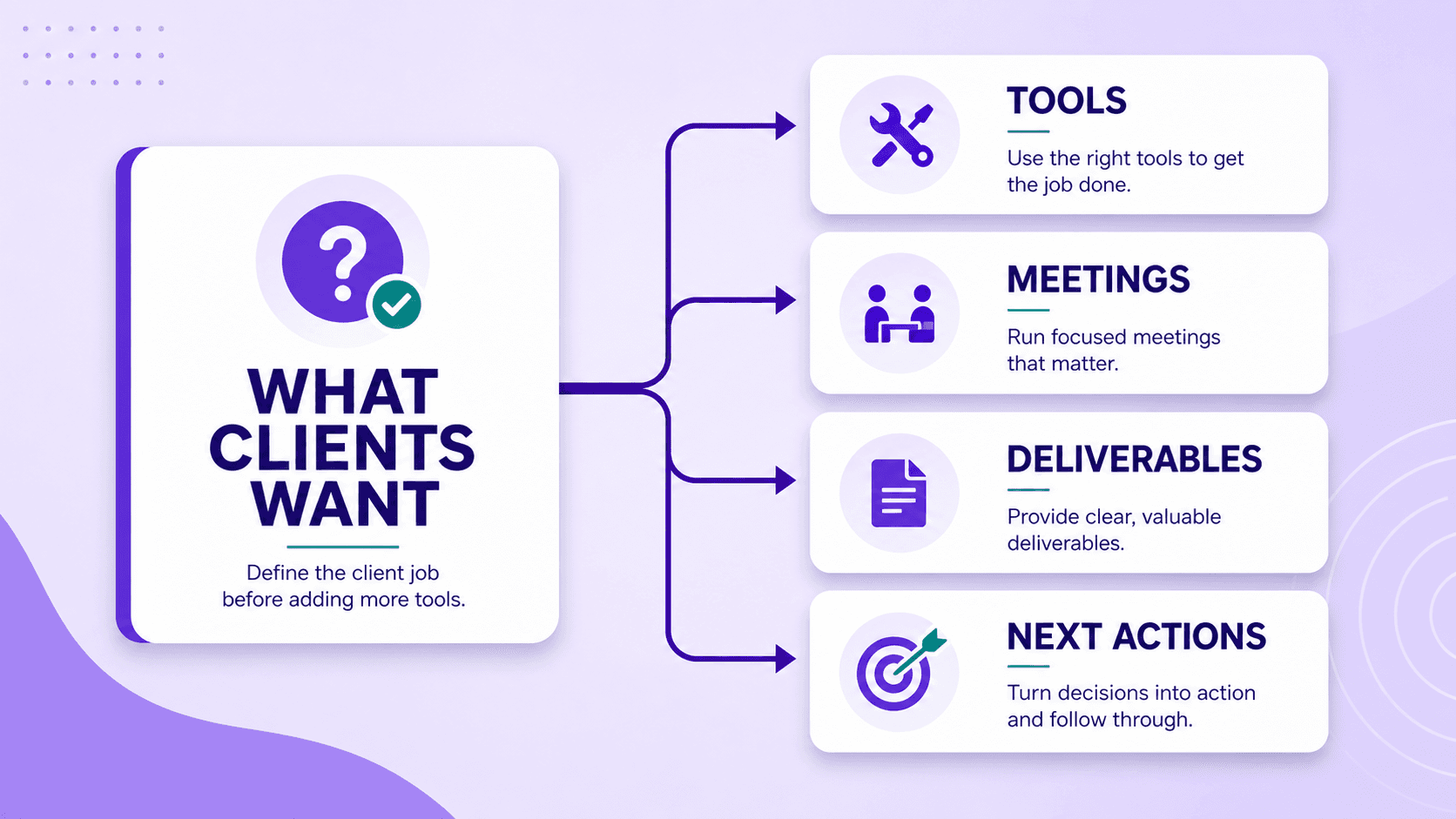
You can look at a tool, meeting, deliverable, or client request and ask whether it supports the job.
You stop building a practice around all the things an advisor could do.
You start building a practice around the things your clients actually need you to do.
The point
Before you buy another planning tool, define the job.
Before you add another deliverable, define the job.
Before you build another meeting, define the job.
For many advisors, the answer may be some version of this:
Help clients understand their financial life and know what to do next.
Your answer might be different. That is fine.
But you need an answer.
Because once you know what you actually do for clients, everything else gets easier to judge.