The 5 Changes in a Financial Plan
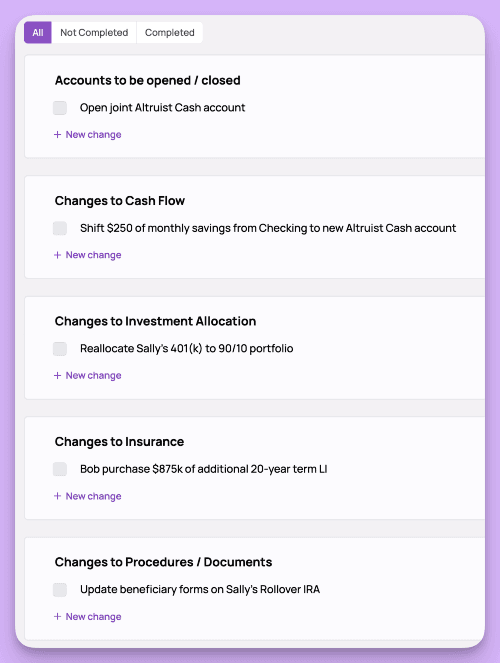
Every piece of financial advice fits into one of 5 groups. The Changes to be Made page IS the financial plan. Everything else is just context.
Clients want to know what they need to do next.
But what does that actually mean? What do they actually care about? How do you identify those items? And most importantly, how do you communicate it with them?
Here's what I know: Staring at a monte carlo projection won't give you the answers and handing clients a 50 page financial plan won't communicate it.
I know that because I tried it.
One week in July 2024, I sat down and reviewed the advice I'd given over the previous 8 years and couple hundred client cases. A pattern emerged.
Everything fit into one of 5 groups.
Open or close accounts
Change where their cash flow was going (e.g., saving or paying debt)
Change what they invested in
Change their insurance coverages
Make document or procedural changes (e.g., update a beneficiary form)
As a test, I started sending clients a word doc attached to an email with my advice grouped into these categories. Clients loved it.
When I built the early version of Kerdora, I knew I wanted to include this "page of changes," but what should I call it?
I thought of some fancy names (e.g., Money Moves, Optimization Strategy), but none of those meant anything. It was just a list of changes to be made, so that's what I called it "Changes to be Made." Clients have never asked me what that page means.
Something else has happened since I've started using this methodology. The "Changes to be made" page IS the financial plan. Everything else is just context.
The Changes to be Made page is a core feature in Kerdora. Throughout the app you can add changes as you note them. Users can:
Add custom groupings
Change the name of groupings
Reorder the groupings
Delete groupings
You can also filter between Open, Completed, and "All" changes to show the progress made since working together.
This is one of the "simplest" features in Kerdora, but like many things in life, one of the most impactful.